Showing posts with label ati. Show all posts

Friday, December 16, 2011

AMD releases Catalyst 11.12 WHQL, 12.1 preview drivers


amd, radeon, catalyst, gpu, graphics, ati, drivers, eyefinity
AMD has graced Radeon owners with two driver updates today: one with Microsoft's blessings and another for the venturesome among us. The WHQL-certified Catalyst 11.12 drivers introduce a bevy of changes, including OpenGL 4.2 support, the ability to enable AMD HD3D when using a 3x1 Landscape Eyefinity configuration, and improved Dual Graphics controls in the Vision Engine Control Center.
Judging by the release notes, 11.12 doesn't contain the speed boosts found in the 11.11c preview driver. There are a ton of bug fixes, however. Graphical anomalies and other hiccups are resolved in Dirt 2, Dirt 3, Portal 2, Shogun 2: Total War, Lost Planet 2, S.T.A.L.K.E.R.: Clear Sky, Tom Clancy's EndWar, Enemy Territory: Quake Wars, Doom 3, Crysis 2, Far Cry 2, Dragon Age 2, Homefront, Metro 2033, BioShock 2 and more.
Download Catalyst 12.1 Preview
Desktop: Windows XP 32/64-bit | Windows Vista/7 32/64-bit
If you want all the performance optimizations, features and bug fixes in Catalyst 11.11c and 11.12, you'll need the 12.1 preview release. In fact, AMD specifically recommends this version for gamers, who would otherwise be missing out. Not only does it contain all of the desired changes, but it offers a few additional perks, including an additional 10-15% speed boost in Skyrim for certain HD 6900-series configurations. Version 12.1 also delivers:
  • Support for 1080p@30Hz displays via HD3D over HDMI 1.4 (up from 24Hz)
  • Improved UI for adjusting video quality and color settings in the control panel
  • A new control panel feature that lets you create application-specific profiles

Tuesday, November 29, 2011

AMD-branded memory coming to the US


Advanced Micro Devices has announced that they will be bringing company-branded memory modules to the United States. The brand will be introduced with two strategic launch partners: Patriot Memory and VisionTek.
AMD has been supplying and validating memory for Radeon graphics cards for years and they feel that jumping into the volatile system memory market is a clear opportunity for the company. They have used the AMD OverDrive performance optimization tool to test and optimize DRAM in conjunction with their APUs, CPUs, GPUs and chipset platforms. Such insight is now helping them create memory modules for other manufacturers as well.
AMD hopes to take the guesswork out of selecting memory by introducing three different performance tiers. All modules will be available in 2GB, 4GB and 8GB capacities. The Entertainment level will feature 1333MHz and 1600MHz speeds designed for quiet home theater PC applications. AMD’s Performance category will support speeds up to 1600MHz in matched pairs with low latency. The top-end Radeon Edition modules will run at 1866MHz and are tuned, tested and certified for specific AMD platforms.
AMD Memory will be available through major retails including Amazon.com, Bestbuy.ca, Fry’s, Memory Express, Micro Center, NCIX, Newegg, Tiger Direct, VIP Computers (UK) and others in the near future. There’s no word on module pricing but given the state of the market, we don’t expect them to carry much of a premium (if any) over existing kits. AMD has been selling similar kits in Japandating back to August, albeit under different performance categories.

Monday, October 3, 2011

Ultrabooks Will Have Hard Times Competing Against Apple MacBook Air


Advanced Micro Devices does not consider Intel Corp.'s ultrabook initiative as an imminent success. The chip designer claims that the market of expensive laptops is dominated by Apple with its MacBook series and ultrabooks will have hard times competing against them. AMD believes that its own approach to offer different chips for inexpensive ultra-slim and multimedia-rich mainstream mobile computers is a very balanced one.
Traditionally ultra low-voltage ultra-portable notebooks were aimed at business users who need long battery life amid sufficient performance and functionality. Many of such ultra-portable computers are state-of-the-art pieces of engineering and employ the latest technologies to provide excellent reliability, stability, battery life, security and other qualities that have tremendous value for those on the road. Ultrabooks should essentially pack the same amount of features, be very responsive, stylish and cost less than $1000, according to Intel’s intentions.
Intel wants ultrabooks to employ its latest-generation microprocessors, use latest technologies available from other developers and still maintain relatively low costs. But AMD believes that there are many ways to address the market of ultra-portable mobile PCs: some may want extremely cheap netbooks with extended battery life and other may want to have powerful multimedia capabilities.
“We have been on the market with our ultra-thin strategy for some time. We have always believed there was a sweet spot in the market: the extreme sort of portability with beautiful aesthetic and very thin designs. […] We have Llano silicon solution today that delivers as good or better battery life than Intel and better all around visual experience. […] The Brazos platform [for low-cost systems] has been a runaway success for AMD,” said John Taylor, the director of client product marketing and software at AMD, in a brief interview with X-bit labs.
Ultra-thin notebook aimed at consumers is not a completely new trend. Back in 2009 Intel already proposed so-called consumer ultra low-voltage (CULV) platform that was supposed to bring ultra-thin notebooks to the masses without using the latest manufacturing technologies and expensive materials. CULV has failed on the market. Ultrabook approach includes high-end materials and precise technology processes, so it is very different.
AMD does not believe in imminent success of ultrabooks and thinks that the new PCs will end up competing against already successful products like Apple MacBook Air, which are powered by the very same Intel Core i-series “Sandy Bridge” microprocessors. Meanwhile, Apple has been dominating the market of expensive consumer PCs for some time now.
"We have to wait and see when the actual thing comes to market and when Windows 8 comes to market and how does the final product [ultrabook hardware and Windows 8 software] look like as a $1000/€1000 type device. And how will it compete against already successful Apple MacBook Air. [...] The $1000+/€1000+ PC market is completely dominated by Apple,” said Mr. Taylor.
AMD asserts that many of the features of so-called ultrabooks are to be based on Windows 8 software and will eventually migrate to mainstream systems.
“Windows 8 brings a number of capabilities that Intel would seem to be collecting under the banner of ultrabook. As well, there are a few things that they are doing with higher-end components that they are looking at that enable faster wake and sleep and this type of capabilities [in Windows 8],” claimed Mr. Taylor.
But while the ultrabook initiative may not be an imminent success, AMD may well have silicon offerings – including, but not limited to the much hyped and not-yet-available code-named Trinity accelerated processing unit – to address the market of highly-responsive and highly-portable laptops that cost less than a $1000.
"I don't want go into specifics around what we can do with Trinity silicon. But Trinity represents a step-up in x86 performance, a step up in graphics performance and a step up in some areas around video, where we are already leaders. I don't want to get too specific about our 2012 roadmaps, but we have two different types of APUs that we can bring to that ultra-thin market as we move forward to their introduction next year," concluded Mr. Taylor.

Sunday, January 2, 2011

HIS Radeon HD 6970 2 GB

HD 6970 Review Introduction


It's finally here! AMD rolled out its latest high-end GPU, codenamed "Cayman", which tops the Northern Islands, AMD's second-generation DirectX 11 compliant GPU family. Using this, AMD is initially carving out two enthusiast-grade products: the AMD Radeon HD 6970 (reviewed here), and the Radeon HD 6950, both released today. There's also scope for a dual-HD 6970-GPU product in the near future, called HD 6990. AMD's Radeon HD 6970 "Cayman" GPU faced quite a few hiccups en route today's launch. It was slated for mid-November, but was delayed by a month due to component shortage. Meanwhile, NVIDIA went ahead with a hard-launch of its GeForce GTX 580 graphics processor, and subsequently, the GeForce GTX 570, to counter the HD 6970.

With Cayman and the HD 6970, AMD is introducing its biggest design change for the GPU's SIMD processing area since Radeon HD 2900 series, it's also introducing a greater amount of parallelism to the graphics engine, and doubling the standard memory amount from 1 GB in the previous generation Radeon HD 5870 and Radeon HD 5850, to 2 GB on both Radeon HD 6970 and HD 6950. As a brief lesson on AMD's naming scheme with this generation, Radeon HD 6950 and HD 6970 represent high-end single GPU SKUs, successors to HD 5800 series, while the recently introduced HD 6800 series are in a segment of their own with no definitive predecessors.


The Radeon HD 6970 from HIS we're reviewing today, sticks to AMD's reference board design, including adherence to reference clock speeds. With HD 6900 series, AMD made sure that users of all HD 6900, including those which are factory-overclocked, have access to reference clock speeds at the turn of a switch (detailed later down the review). The Radeon HD 6970 features 2 GB of GDDR5 memory, carries clock speeds of 880 MHz core and 1375 MHz (5500 MHz GDDR5 effective); and display outputs including two DVI, one HDMI 1.4a, and two mini DisplayPort 1.2.


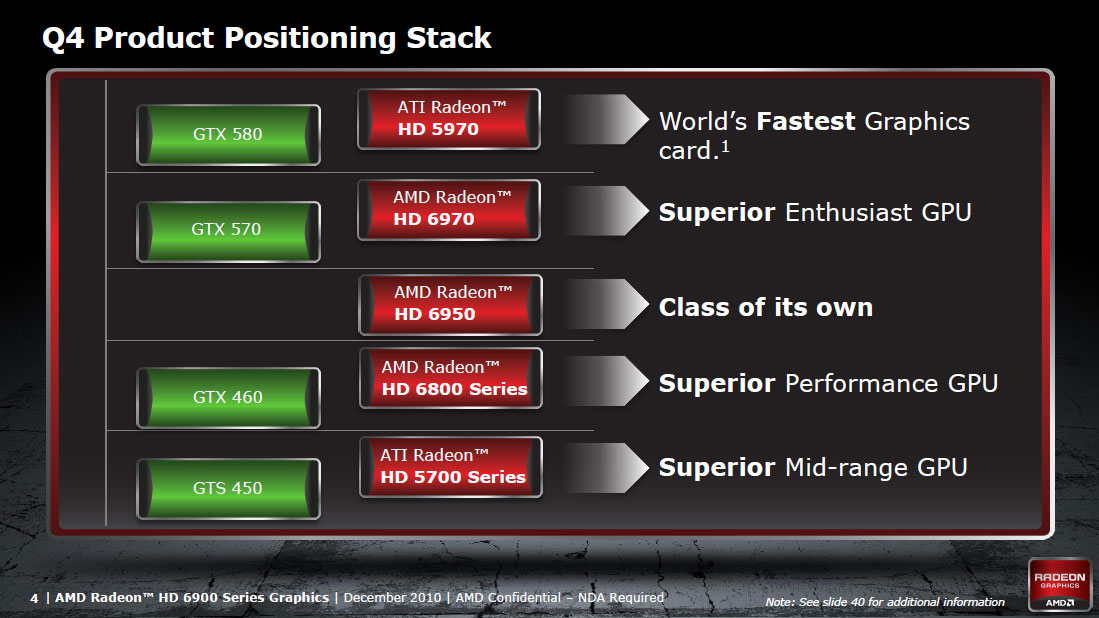
Product Positioning

This slide from AMD instantly tells you the amount of damage the surprise hard-launch of NVIDIA GeForce 580 and GTX 570 caused to the HD 6970 and HD 6950 positioning. Take those two out of the equation, and we're actually seeing the GTX 480 (which has roughly the same performance as GTX 570) being edged past by HD 6970, and HD 6950 way ahead of whatever else is down there from NVIDIA (GTX 470, GTX 460 1 GB).

AMD is still banking on the previous-generation HD 5970 dual-GPU graphics card to hold the performance leadership (which it is loosely holding on to, with the potential of losing it to the GTX 580 with one good GeForce driver snatching that leadership); HD 6970 to be a notch lower in price but somewhere between GTX 570 and GTX 580 in terms of performance.


Radeon
HD 6850
Radeon
HD 5850
GeForce
GTX 470
Radeon
HD 6870
Radeon
HD 5870
Radeon
HD 6950
GeForce
GTX 570
GeForce
GTX 480
Radeon
HD 6970
GeForce
GTX 580
Radeon
HD 5970
Shader units 960144044811201600140848048015365122x 1600
ROPs323240323232404832482x 32
GPUBartsCypressGF100BartsCypressCaymanGF110GF100CaymanGF1102x Cypress
Transistors1700M2154M3200M1700M2154M2640M3000M3200M2640M3000M2x 2154M
Memory Size1024 MB1024 MB1280 MB1024 MB1024 MB2048 MB1280 MB1536 MB2048 MB1536 MB2x 1024 MB
Memory Bus Width 256 bit 256 bit 320 bit 256 bit 256 bit 256 bit 320 bit 384 bit 256 bit 384 bit 2x 256 bit
Core Clock775 MHz 725 MHz 607 MHz 900 MHz 850 MHz 800 MHz 732 MHz 700 MHz 880 MHz 772 MHz 725 MHz
Memory Clock1000 MHz 1000 MHz 837 MHz 1050 MHz 1200 MHz 1250 MHz 950 MHz 924 MHz 1375 MHz 1002 MHz 1000 MHz
Price$180$260$260$240$360$300$330$450$370$500$580

Wednesday, December 29, 2010

Radeon HD 6990

AMD on Tuesday quietly announced that it would delay the roll-out of the company's next-generation flagship graphics product powered by two code-named Cayman chips. From the fourth quarter of this year, the new graphics board known as the Radeon HD 6990 or under code-name Antilles will be delayed to the first quarter of 2011 reports Xbitlabs.

At the financial analyst day AMD's graphics business unit quietly revealed a new roadmap for the short-term future. Based on the new roadmap, the company's highest-performance dual-chip Radeon HD 6990 "Antilles" will only be released in Q1 2011, which is a delay by several weeks from earlier unveiled roadmaps that were published on the Internet. In addition, AMD intends to release its code-named Turks and Caicos chips in the first quarter of next year.

The Radeon HD 6970 and 6950 based on code-named Cayman chip will be released this quarter, as planned.

At present specifications of ATI Radeon HD 6900-serires graphics processors as well as boards on their base are unknown, as a result it is impossible to make any predictions about speed levels in games offered by Cayman or Antilles products.

Considering the fact that Nvidia Corp. has just released its new flagship GeForce GTX 580, which offers up to 30% of performance increase over GeForce GTX 480 and generally offers a number of advantages compared to Radeon HD 5970, formally the highest-end consumer graphics card on the market, the delay of the Radeon HD 6990 is not a good news for AMD. The company's share on desktop discrete GPU market dropped from Q2 2010 to Q3 2010 slightly (from 44% to 41%, according to Mercury Research) after Nvidia released its GeForce GTX 460-series of graphics boards; the launch of a new flagship solution will impact sales of AMD's most lucrative high-end graphics boards and will also capture minds of high-performance graphics enthusiasts. The good news for the company is that its single-chip high-end offerings based on Cayman GPU are still on-track for the fourth quarter launch.
It should be noted that technically AMD can still announce the Radeon HD 6990 "Antilles" in 2010 in order to distract attention from Nvidia's new offering, however, even the company itself understands that the novelty will only be available in 2011 - Source xbitlabs

BTW we have not been able to verify this with AMD as of yet. We can however notce that the Cayman release is still on track as scheduled for a November release.