Showing posts with label Radeon. Show all posts

Friday, August 23, 2013

AMD next-gen Radeon 'Hawaii' graphics cards expected in October


AMD is reportedly preparing to mass ship their next generation high-end GPU codenamed Hawaii in October according to sources in the upstream supply chain as reported by DigiTimes. When you consider AMD is flying a number of journalists to Hawaii (no coincidence there) late next month for a “technical showcase,” this rumor quickly becomes much more credible.

Friday, July 20, 2012

6GB VGA Dual-GPU Radeon HD 7990


AMD is following up from the launch of its Radeon HD 7970 GHz edition graphics card, which sought to take the single-GPU performance crown from Nvidia’s GTX 680 late last month, with a new round of price cuts that will affect several of its mid- and high-end GCN based offerings. The move comes as gamers await AMD’s rumored launch of the dual-GPU HD 7990 later this month to take on Nvidia’s GTX 690.

The new prices will go into effect starting today. Among them, the 7970 will have it's price dropped from $479 to $429, the 7950 from $399 to $349, and the 7870 from $349 to $299. These represent a significant drop over the launch prices of $549, $449 and $399 respectively. Here’s the full breakdown:

GPULaunch priceSpring MSRPSummer MSRP
Radeon HD 7970$549$479$429
Radeon HD 7950$449$399$349
Radeon HD 7870$349$349$299
Radeon HD 7850$249$249~$239
Radeon HD 7770$159$139~$119
Radeon HD 7750$109$109~$99
As AnandTech notes, since AMD can’t control final card pricing beyond what they charge partners for parts, unofficially some of these prices, or even lower ones, were already available at retailers like Newegg -- right now a Radeon HD 7950 from MSI can be found for as low as $340, for example.
Later this month AMD is expected to launch its dual-GPU Radeon HD 7990, which will go head-to-head against the GeForce GTX 690. Specs will reportedly include two Tahiti XT (Radeon HD 7970) cores packing a total of 4096 stream processors clocked at 1 GHz, 6GB of GDDR5 memory (3GB per GPU) clocked at 1250 MHz, and the ability to drive 6-monitor Eyefinity configurations out-of-the-box.
The card will be launched in limited quantities. Judging by availability of the new 7970 GHz Edition it might take a few weeks until consumers can find AMD’s upcoming dual-GPU flagship in stores.

Tuesday, December 27, 2011

AMD announces Radeon HD 7970, claims fastest GPU title


AMD has officially announced its first ever 28nm-based graphics card: the Radeon HD 7970. The first member of the 'Southern Islands' GPU family is based on the 'Tahiti' core and utilizes a fresh architecture AMD refers to as "Graphics Core Next." The latter introduces a non-VLIW SIMD engine and is claimed to deliver a big improvement in performance per square millimeter of GPU space over the prior generation.

Spec-wise, the Radeon HD 7970 packs 2048 Stream Processors, 128 Texture Units, 32 ROPs, a core clock of 925 MHz, a 384-bit memory interface, and 3 GB of GDDR5 memory clocked at 5500 MHz. It has the highest transistor count of any GPU yet at 4.31 billion and offers massive improvements over the previous single-GPU flagship -- 3.79TFLOPs of theoretical computing performance compared to 2.7TFLOPs for the Radeon HD 6970, and 264GB/sec of memory bandwidth over the 176GB/sec of the 6970.

Cards in the 7900 series can make full use of the newest and speediest PCI Express (PCIe) 3.0 x16 bus interface, though they will retain backwards compatibility with both 1.0 and 2.0 standards.

Other enhancements include PowerTune and AMD ZeroCore Power technologies, which allow for higher performance levels while maximizing power efficiencies, App Acceleration to improve HD video playback and general performance, and an update to AMD's Eyefinity technology that brings new monitor configurations (up to 5-by-1 landscape and portrait with  2560 x 1600 monitors), flexible bezel compensation, stereoscopic 3D support across three displays and support for up to five independent audio streams.

AnandTech tested AMD's newest card and summarizes its gaming performance and power usage like this: "Depending on the game being tested it’s anywhere between 5% and 35% faster than NVIDIA’s GeForce GTX 580, averaging 15% to 25% depending on the specific resolution in use. Furthermore thanks to TSMC's 28nm process power usage is upwards of 50W lower than the GTX 580, but it’s still higher than the 6970 it replaces."

The reference AMD Radeon HD 7970 card features a dual-slot cooler which uses vapor chamber technology, has CrossFireX support, and includes four display outputs: one dual-link DVI, one HDMI 1.4a and two mini DisplayPort 1.2. It'll arrive in January 9 just ahead of CES with a price tag of $549.

Monday, December 19, 2011

AMD's mid-range Radeon HD 7770 poses for the camera


Pictures of AMD's upcoming Radeon HD 7770 mainstream graphics card have leaked online courtesy of a forum member at Rage3D. The new card is based on the 28nm Cape Verde GPU, which is a direct replacement for Juniper, and represents the first major upgrade to the Radeon HD 5770 in two years since the last generation Radeon HD 6770 was basically a rebrand based on the same GPU core as its predecessor.
The shots were not accompanied by technical specifications but there are a few things we can take away from looking at the card. The Radeon HD 7770 looks rather similar to Nvidia's GeForce GTX 460, with a dual-slot design and a large diameter fan in the middle pushing air down vertically.

The GPU itself is quite small and Fudzilla ventures to guess it should measure up at under 150mm2. The reference card includes the usual three display outputs -- DVI, HDMI and miniDisplayPort. A single 6-pin PCI-e is used to power the card, suggesting a TDP below 150W, and possibly close to 100W according to reports. There's also a single Crossfire connector for up to two-card configurations and the four GDDR5 memory chips on the exposed PCB indicate a possible 128-bit memory interface.

According to Fudzilla, the Radeon HD 7700 series is scheduled to arrive sometime around mid-February. The Cape Verde GPU powering these cards will be based on AMD's Graphics Core Next architecture, while everything below the series is expected to be rebrands of the VLIW5 HD 6000 family with few minor tweaks.

Friday, December 16, 2011

AMD releases Catalyst 11.12 WHQL, 12.1 preview drivers


amd, radeon, catalyst, gpu, graphics, ati, drivers, eyefinity
AMD has graced Radeon owners with two driver updates today: one with Microsoft's blessings and another for the venturesome among us. The WHQL-certified Catalyst 11.12 drivers introduce a bevy of changes, including OpenGL 4.2 support, the ability to enable AMD HD3D when using a 3x1 Landscape Eyefinity configuration, and improved Dual Graphics controls in the Vision Engine Control Center.
Judging by the release notes, 11.12 doesn't contain the speed boosts found in the 11.11c preview driver. There are a ton of bug fixes, however. Graphical anomalies and other hiccups are resolved in Dirt 2, Dirt 3, Portal 2, Shogun 2: Total War, Lost Planet 2, S.T.A.L.K.E.R.: Clear Sky, Tom Clancy's EndWar, Enemy Territory: Quake Wars, Doom 3, Crysis 2, Far Cry 2, Dragon Age 2, Homefront, Metro 2033, BioShock 2 and more.
Download Catalyst 12.1 Preview
Desktop: Windows XP 32/64-bit | Windows Vista/7 32/64-bit
If you want all the performance optimizations, features and bug fixes in Catalyst 11.11c and 11.12, you'll need the 12.1 preview release. In fact, AMD specifically recommends this version for gamers, who would otherwise be missing out. Not only does it contain all of the desired changes, but it offers a few additional perks, including an additional 10-15% speed boost in Skyrim for certain HD 6900-series configurations. Version 12.1 also delivers:
  • Support for 1080p@30Hz displays via HD3D over HDMI 1.4 (up from 24Hz)
  • Improved UI for adjusting video quality and color settings in the control panel
  • A new control panel feature that lets you create application-specific profiles

Tuesday, November 29, 2011

AMD-branded memory coming to the US


Advanced Micro Devices has announced that they will be bringing company-branded memory modules to the United States. The brand will be introduced with two strategic launch partners: Patriot Memory and VisionTek.
AMD has been supplying and validating memory for Radeon graphics cards for years and they feel that jumping into the volatile system memory market is a clear opportunity for the company. They have used the AMD OverDrive performance optimization tool to test and optimize DRAM in conjunction with their APUs, CPUs, GPUs and chipset platforms. Such insight is now helping them create memory modules for other manufacturers as well.
AMD hopes to take the guesswork out of selecting memory by introducing three different performance tiers. All modules will be available in 2GB, 4GB and 8GB capacities. The Entertainment level will feature 1333MHz and 1600MHz speeds designed for quiet home theater PC applications. AMD’s Performance category will support speeds up to 1600MHz in matched pairs with low latency. The top-end Radeon Edition modules will run at 1866MHz and are tuned, tested and certified for specific AMD platforms.
AMD Memory will be available through major retails including Amazon.com, Bestbuy.ca, Fry’s, Memory Express, Micro Center, NCIX, Newegg, Tiger Direct, VIP Computers (UK) and others in the near future. There’s no word on module pricing but given the state of the market, we don’t expect them to carry much of a premium (if any) over existing kits. AMD has been selling similar kits in Japandating back to August, albeit under different performance categories.

Thursday, March 10, 2011

AMD Radeon HD 6990 Review: Sumptuous Dual-GPU Power

AMD introduced its first Radeon HD 6000 graphics card last October, when we reviewed the mid-range Radeon HD 6870. Since then AMD opened up to show its GPU roadmap and the cards that soon thereafter were coming to market.
The high-end Radeon HD 6970 and HD 6950 also arrived late last year, while the dual-GPU version of AMD's last generation graphics series code-named Antilles was expected to arrive shortly after. Coincidentally (or not) both AMD and Nvidia took a few months longer than expected to show its hardcore dual-GPU graphics cards, with the former making the first move to finally unveil the Radeon HD 6990.

Having looked at most of the previous generation Crossfire and SLI products, we were certainly looking forward to see what AMD had in store for us with this dual-GPU monster.

We don't think AMD sells large volumes of these dual-GPU cards, in fact, previous versions of their topmost offerings have been known to disappear from retail temporarily and then stock back up again. Having that said, the Radeon HD 6990 is an important product on AMD's line-up as it can do a lot for the series reputation, just as the HD 5970 did before.

With both AMD and Nvidia trying hard to push its graphics technologies beyond PC gaming, including the use of embedded graphics in motherboards and processors, that has also meant that the discrete GPU market on the low-end segment is shrinking and thus mid-range offerings are taking a new level of precedence.


Holding the performance crown can be a big deal, and AMD did so uncontested for quite some time with the Radeon HD 5970. As you may recall, the GeForce GTX 400 series was simply too hot to stick a pair of GPUs on a single PCB and therefore Nvidia was never able to respond with a dual-GPU offering of their own. Nvidia has overcome all those issues now, having also released their latest generation architecture with multiple GeForce 500 series products on offer today.


The GeForce GTX 580 is able to match the dual-GPU Radeon HD 5970 and even beat it in a number of areas. With the arrival of the Radeon HD 6990, AMD is hoping to take back the performance crown which they will likely hold until the GeForce GTX 590 arrives.


Under the hood, the Radeon HD 6990 is essentially a pair of underclocked Radeon HD 6970 GPUs on top of a massive PCB. This is the same of what we found with the Radeon HD 5970 which featured a pair of HD 5870 GPUs operating at slightly lower frequencies.


When designing the older Radeon HD 5970, AMD worked hard to keep within the PCI Express specification which calls for a maximum TDP of 300 watts. At 294 watts the HD 5970 just scrapped in and was still the most power hungry graphics card of its time. However, the new Radeon HD 6990 is much closer in specification to the HD 6970 than the HD 5970 was to the HD 5870. As a result the card's TPD rating has increased to a staggering 375 watts.


Perhaps for some that won't be the biggest shocker. The new Radeon 6990 is set to sell for $699, which translates in a $100 premium versus the HD 5970's price at launch. At this price point gamers can alternatively purchase a pair of Radeon HD 6970 cards and still save a few bucks while scoring a little extra performance. With that in mind, let’s check out the almighty Radeon HD 6990 in better detail...

Thursday, February 17, 2011

AMD Radeon HD 6950 Review


After much anticipation AMD launched their Radeon HD 6900 series earlier this month. Many hoped that the new HD 6970 would go head to head with the GeForce GTX 580, possibly forcing Nvidia to make price cuts. However with a retail price that was undercutting the competition's flagship board, the slower HD 6970 was destined to take on theGTX 570 instead.
In a sense this is better news for the mass of consumers, as the Radeon HD 6970 is a far more realistic product for most gamers at $369 than the GeForce GTX 580 is at $499. The HD 6970 held its own in our review and when compared to the GeForce GTX 570 the result couldn't have been any tighter. Both graphics cards delivered the same experience at 1920x1200, while the HD 6970 was slightly faster at 2560x1600.

If the $350-380 price tag is too hard to justify, the Radeon HD 6870 and GeForce GTX 460 are more affordable alternatives in the $200-240 range, though they are quite a bit slower.


The previous generation Radeon HD 5870 offers a fraction more performance at around $280. Meanwhile, Nvidia is still offering the (not very efficient but speedy) GeForce GTX 470 for around $249, which makes the Radeon HD 5870 a tough sell these days.


Therefore, between the GeForce GTX 470 at $250 and the GeForce GTX 570 at $350 there is a $100 price gap with no real contenders -- at least until AMD launched their new $299 Radeon HD 6950 graphics card. At this price point, the Radeon HD 6950 has no direct competition, but we'll be keeping a close eye on how it compares to the GTX 470 and 570 and whether it makes more sense to scale down or up to get better value.


Much of the information covered here was already reviewed in our Radeon HD 6970 review earlier this month, so feel free to skip this page if you read that already.


The high-end "Cayman" architecture used by the Radeon HD 6900 series is a little different from Barts, which debuted with the Radeon HD 6870 and HD 6850 graphics cards.


Barts used the same VLIW5 configuration as the Radeon HD 5000 series, which features SIMD units with 4 simple and 1 complex stream processing unit.


The Radeon HD 6900 series, however, adopts a VLIW4 configuration, which features stream processing units arranged in groups of four along with general purpose registers. Although the four have equal capabilities, two (occupying 3 and 4 issue slots) are assigned with some special functions. AMD claims that VLIW4 configuration gives similar computational power as VLIW5, with 10% reduction in die area.

The Cayman GPUs feature a greater level of parallelization when compared to the Evergreen/Cypress architecture used by the Radeon HD 5800 series. Barts GPUs sit somewhere in the middle, as they were a step up from Cypress in assigning individual dispatch processors for each of the two SIMD Engine blocks.

The Cayman GPUs take things a step further with dual GPEs (Graphics Processing Engines) and assigning each to an SIMD engine block. What this means is that the Cayman architecture* now features two physical tessellation units whereas Barts only featured a single tessellation unit with improved efficiency when compared to the Radeon HD 5800 series as claimed by AMD.

What this means for the Radeon HD 6900 series is that tessellation performance can be improved quite significantly. In fact, AMD is claiming up to 3x the performance of the Radeon HD 5870 in these scenarios which, as you might remember, were the ones Nvidia liked to point out when claiming Fermi was architecturally superior than previous-generation Radeons.

In addition, the Cayman architecture also features reworked render backends consisting of 128 Z/Stencil ROPs, and 32 color ROPs, with up to 2x faster 16-bit integer operations and 2-4x faster 32-bit floating-point operations.

Note: For sake of simplicity we have referred to Cayman and Barts codenames that identify the high-end and mid-range desktop products in AMD's latest 6000-series GPU family (codenamed "Northern Islands" as a whole).

Radeon HD 6950 Board in Detail
Like its bigger brother, the Radeon HD 6950 still measures 27cm long (10.6 in), the typical length for today's high-end graphics cards. For example, the old Radeon HD 4870 X2 graphics card measures 28cm long, as does the more recent Radeon HD 5870. The Radeon HD 6950 is also the same length as the more expensive GeForce GTX 580 graphics card.

Just as its predecessor, the Radeon HD 6950 GPU has been fabricated using the 40nm process, yet AMD has squeezed in 486 million more transistors resulting in a die increase of 16%.

The GPU core is clocked at 800MHz, 9% lower than the Radeon HD 6970, while the GDDR5 memory also operates 9% slower at 1250MHz. Pairing that frequency with a 256-bit wide memory bus gives the Radeon HD 6950 a theoretical bandwidth of 160GB/s which, as you may have guessed, is 9% less than the HD 6970.

The Radeon HD 6950 also differs from the more expensive HD 6970 in its core configuration. Whereas the Radeon HD 6970 featured 1536 SPUs, 96 TAUs and 32 ROPs, the cut down HD 6950 packs 1408 SPUs, 88 TAUs, and the same 32 ROPs (8% less SPUs and TAUs).

Cooling the "Cayman Pro" GPU is a fairly large aluminum vapor chamber heatsink made up of 39 fins measuring 13.5cm long, 6.5cm wide, and 2.5cm tall. The vapor chamber design was first implemented in the Radeon HD 5970 and has recently also been adopted by Nvidia with their GeForce GTX 580 and GTX 570 graphics cards. Cooling the heatsink is a 75x20mm blower fan that draws air in from the case and pushes it out through the back.

For the most part, this fan operates very quietly, helped by the impressively low 20 watt idle consumption of the Radeon HD 6950. When gaming the fan will spin up as the card can consume up to 200 watts under load. This is ~6% more than the Radeon HD 5870, but even with the increased thermal stress, the fan didn't scream at intolerable levels.

The heatsink and fan have been enclosed within a custom-built housing that conceals the entire graphics card, a common practice for AMD when designing their most elite cards. We actually like this setup, as it helps protect the product very well. Nvidia has also done this in the past with their most prized graphics cards, such as the GeForce GTX 295 (dual GPU), though they have not used this design for their most recent flagship product, the GeForce GTX 580.

In order to feed the card enough power, AMD includes dual 6-pin PCI Express power connectors. This is the same setup used on the Radeon HD 5870, HD 6870 and GeForce GTX 580, GTX 570 graphics cards, so it's a configuration usually employed by high-end graphics cards.

Naturally, the Radeon HD 6950 supports Crossfire, so it has a pair of connectors to bridge two or more cards together. The only other connectors are on the I/O panel. Our AMD reference sample featured two dual DL-DVI connectors, a single HDMI 1.4a port, and two mini-DisplayPort 1.2 sockets.

It's worth noting that all Radeon HD 6950 graphics cards can support a max resolution of 2560x1600 on up to three monitors. With a multi-stream hub using the mini-DisplayPort 1.2 sockets, the card can power up to six monitors.


Test System Specs & 3Dmark 11
Test System Specs
- Intel Core i7 920 (Overclocked @ 3.70GHz)
- x3 2GB G.Skill DDR3 PC3-12800 (CAS 9-9-9-24)
- Asus P6T Deluxe (Intel X58)
- OCZ GameXStream (700W)
- Seagate 500GB 7200-RPM (Serial ATA300)
- Gigabyte Radeon HD 6970 (2GB)
- AMD Radeon HD 6950 (2GB)
- AMD Radeon HD 6870 (1GB)
- AMD Radeon HD 5970 (2GB)
- AMD Radeon HD 5870 (1GB)
- HIS Radeon HD 5850 (1GB)
- AMD Radeon HD 5830 (1GB)
- HIS Radeon HD 5770 (1GB)
- HIS Radeon HD 5750 (1GB)
- Asus GeForce GTX 580 (1.5GB)
- Gigabyte GeForce GTX 570 (1.3GB)
- Inno3D GeForce GTX 480 (1.5GB)
- Palit GeForce GTX 470 (1.3GB)
- Gigabyte GeForce GTX 460 (1GB)
- Palit GeForce GTS 450 (1GB)
Software
- Microsoft Windows 7 Ultimate 64-bit
- Nvidia Forceware 263.09
- AMD Catalyst 10.11
- AMD Radeon_HD6900 8.79.6.2RC2 Dec7


Using the new Futuremark 3Dmark 11 benchmark, the Radeon HD 6950 was 20% faster than the GeForce GTX 470 when running the extreme test. Should this be the case when running actual games this could be very good news for AMD.

The same test also reported that the Radeon HD 6950 was ~5% slower than the GeForce GTX 570 and 12% slower than the HD 6970 while it was just 2% faster than the HD 5870.

Sunday, January 2, 2011

HIS Radeon HD 6970 2 GB

HD 6970 Review Introduction


It's finally here! AMD rolled out its latest high-end GPU, codenamed "Cayman", which tops the Northern Islands, AMD's second-generation DirectX 11 compliant GPU family. Using this, AMD is initially carving out two enthusiast-grade products: the AMD Radeon HD 6970 (reviewed here), and the Radeon HD 6950, both released today. There's also scope for a dual-HD 6970-GPU product in the near future, called HD 6990. AMD's Radeon HD 6970 "Cayman" GPU faced quite a few hiccups en route today's launch. It was slated for mid-November, but was delayed by a month due to component shortage. Meanwhile, NVIDIA went ahead with a hard-launch of its GeForce GTX 580 graphics processor, and subsequently, the GeForce GTX 570, to counter the HD 6970.

With Cayman and the HD 6970, AMD is introducing its biggest design change for the GPU's SIMD processing area since Radeon HD 2900 series, it's also introducing a greater amount of parallelism to the graphics engine, and doubling the standard memory amount from 1 GB in the previous generation Radeon HD 5870 and Radeon HD 5850, to 2 GB on both Radeon HD 6970 and HD 6950. As a brief lesson on AMD's naming scheme with this generation, Radeon HD 6950 and HD 6970 represent high-end single GPU SKUs, successors to HD 5800 series, while the recently introduced HD 6800 series are in a segment of their own with no definitive predecessors.


The Radeon HD 6970 from HIS we're reviewing today, sticks to AMD's reference board design, including adherence to reference clock speeds. With HD 6900 series, AMD made sure that users of all HD 6900, including those which are factory-overclocked, have access to reference clock speeds at the turn of a switch (detailed later down the review). The Radeon HD 6970 features 2 GB of GDDR5 memory, carries clock speeds of 880 MHz core and 1375 MHz (5500 MHz GDDR5 effective); and display outputs including two DVI, one HDMI 1.4a, and two mini DisplayPort 1.2.


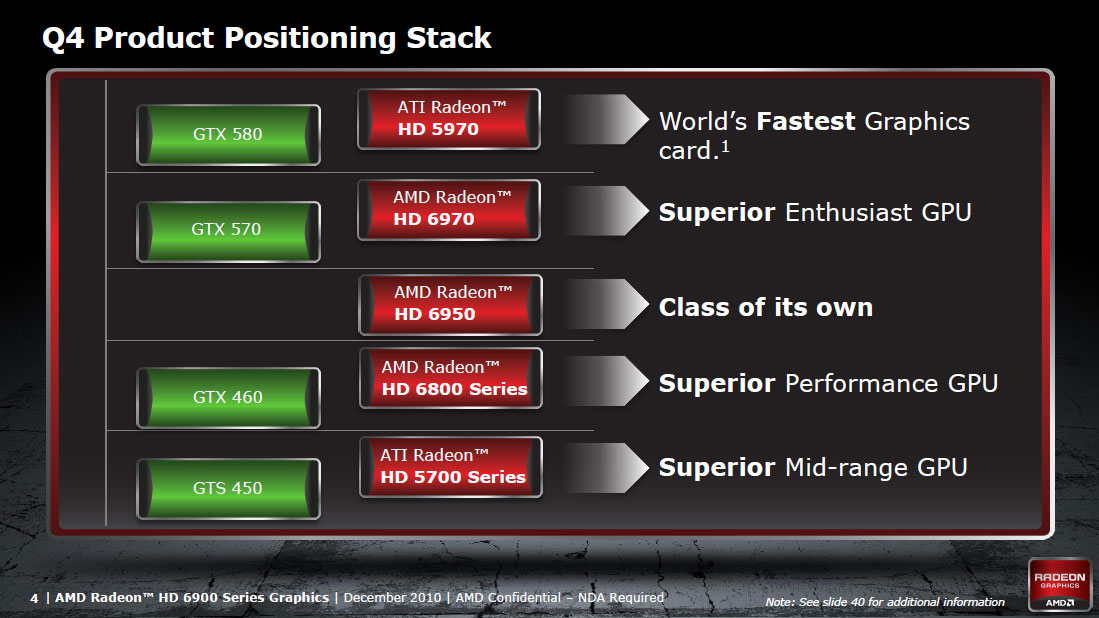
Product Positioning

This slide from AMD instantly tells you the amount of damage the surprise hard-launch of NVIDIA GeForce 580 and GTX 570 caused to the HD 6970 and HD 6950 positioning. Take those two out of the equation, and we're actually seeing the GTX 480 (which has roughly the same performance as GTX 570) being edged past by HD 6970, and HD 6950 way ahead of whatever else is down there from NVIDIA (GTX 470, GTX 460 1 GB).

AMD is still banking on the previous-generation HD 5970 dual-GPU graphics card to hold the performance leadership (which it is loosely holding on to, with the potential of losing it to the GTX 580 with one good GeForce driver snatching that leadership); HD 6970 to be a notch lower in price but somewhere between GTX 570 and GTX 580 in terms of performance.


Radeon
HD 6850
Radeon
HD 5850
GeForce
GTX 470
Radeon
HD 6870
Radeon
HD 5870
Radeon
HD 6950
GeForce
GTX 570
GeForce
GTX 480
Radeon
HD 6970
GeForce
GTX 580
Radeon
HD 5970
Shader units 960144044811201600140848048015365122x 1600
ROPs323240323232404832482x 32
GPUBartsCypressGF100BartsCypressCaymanGF110GF100CaymanGF1102x Cypress
Transistors1700M2154M3200M1700M2154M2640M3000M3200M2640M3000M2x 2154M
Memory Size1024 MB1024 MB1280 MB1024 MB1024 MB2048 MB1280 MB1536 MB2048 MB1536 MB2x 1024 MB
Memory Bus Width 256 bit 256 bit 320 bit 256 bit 256 bit 256 bit 320 bit 384 bit 256 bit 384 bit 2x 256 bit
Core Clock775 MHz 725 MHz 607 MHz 900 MHz 850 MHz 800 MHz 732 MHz 700 MHz 880 MHz 772 MHz 725 MHz
Memory Clock1000 MHz 1000 MHz 837 MHz 1050 MHz 1200 MHz 1250 MHz 950 MHz 924 MHz 1375 MHz 1002 MHz 1000 MHz
Price$180$260$260$240$360$300$330$450$370$500$580

Wednesday, December 29, 2010

Radeon HD 6990

AMD on Tuesday quietly announced that it would delay the roll-out of the company's next-generation flagship graphics product powered by two code-named Cayman chips. From the fourth quarter of this year, the new graphics board known as the Radeon HD 6990 or under code-name Antilles will be delayed to the first quarter of 2011 reports Xbitlabs.

At the financial analyst day AMD's graphics business unit quietly revealed a new roadmap for the short-term future. Based on the new roadmap, the company's highest-performance dual-chip Radeon HD 6990 "Antilles" will only be released in Q1 2011, which is a delay by several weeks from earlier unveiled roadmaps that were published on the Internet. In addition, AMD intends to release its code-named Turks and Caicos chips in the first quarter of next year.

The Radeon HD 6970 and 6950 based on code-named Cayman chip will be released this quarter, as planned.

At present specifications of ATI Radeon HD 6900-serires graphics processors as well as boards on their base are unknown, as a result it is impossible to make any predictions about speed levels in games offered by Cayman or Antilles products.

Considering the fact that Nvidia Corp. has just released its new flagship GeForce GTX 580, which offers up to 30% of performance increase over GeForce GTX 480 and generally offers a number of advantages compared to Radeon HD 5970, formally the highest-end consumer graphics card on the market, the delay of the Radeon HD 6990 is not a good news for AMD. The company's share on desktop discrete GPU market dropped from Q2 2010 to Q3 2010 slightly (from 44% to 41%, according to Mercury Research) after Nvidia released its GeForce GTX 460-series of graphics boards; the launch of a new flagship solution will impact sales of AMD's most lucrative high-end graphics boards and will also capture minds of high-performance graphics enthusiasts. The good news for the company is that its single-chip high-end offerings based on Cayman GPU are still on-track for the fourth quarter launch.
It should be noted that technically AMD can still announce the Radeon HD 6990 "Antilles" in 2010 in order to distract attention from Nvidia's new offering, however, even the company itself understands that the novelty will only be available in 2011 - Source xbitlabs

BTW we have not been able to verify this with AMD as of yet. We can however notce that the Cayman release is still on track as scheduled for a November release.