Enabling these new processors was the LGA1155 platform, which brought about three new chipsets. Two of these, the H67 and P67, went on to spoil what would have otherwise been perfect execution by Intel. Plagued by a SATA 3Gb/s bug, this put the entire platform on hold for numerous months until Intel could ramp up production of working B3 stepping chipsets to replace the defective models, effectively costing Intel a billion dollars or thereabouts.
By March the company was on the mend and before long it was all about Sandy Bridge. Intel described its production increase for the microprocessor as the fastest ramp-up of any product in the company’s history.
With the Sandy Bridge processors hitting full stride, the recent release of AMD’s Bulldozer processorswas not enough to slow sales. This was largely due to Bulldozer’s inability to compete well enough with the Core i5-2xxx series. Even worse than that, it's next to impossible to actually buy an AMD FX-8150 processor thanks to chip shortages. Meanwhile, Intel is preparing to strike back by bolstering their 2nd generation Core processors even further.
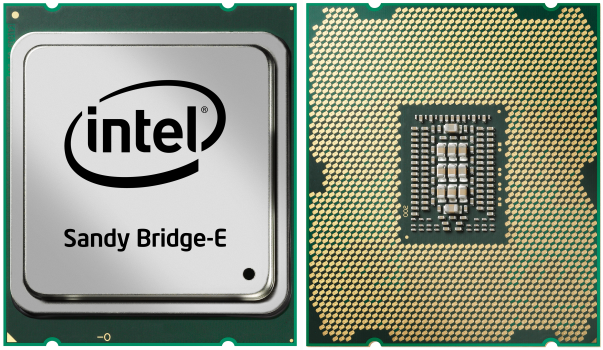
Today marks the arrival of Sandy Bridge-E and three new processors released initially, which include the Core i7-3960X Extreme Edition, Core i7-3930K and Core i7-3820. Powered by a new LGA2011 socket, these 32nm processors provide up to six cores with a dozen threads. Intel has also upgraded the integrated memory controller with four channels supporting DDR3-1600 memory, for a theoretical peak bandwidth of 51.2GB/s.
These processors will be explored in greater detail shortly, but for now it's worth mentioning they feature a total of 2.27 billion transistors in a die size of 20.8mm by 20.9mm, which are mind-boggling stats to say the least.
Sandy Bridge-E Lineup
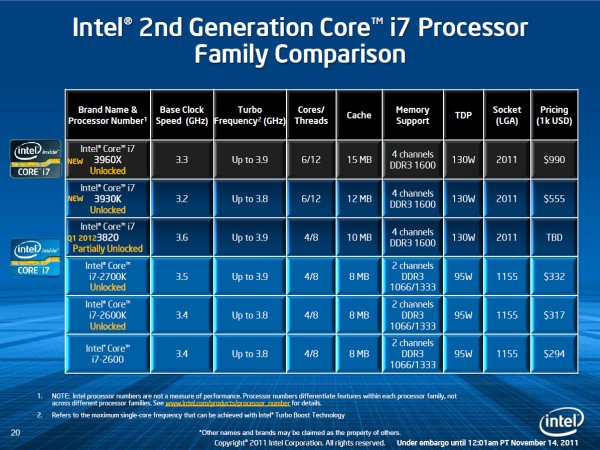
The Sandy Bridge-E launch lineup consists of three processors. King of the hill is the Core i7 3960X Extreme Edition, a fully unlocked chip featuring 6 cores with Hyper-Threading for 12 thread support. This model comes clocked at 3.3GHz with a Turbo frequency of up to 3.9GHz and TDP rating of 130 watts.


Like all Sandy Bridge-E processors it supports quad-channel DDR3-1600 memory. However unlike some Extreme Edition models, the new Core i7 3960X receives a massive 15MB L3 cache which is shared across all six cores. The 3960X sticks to the conventional Extreme Edition pricing with a MSRP of $990.
Under the Core i7-3960X we have the more reasonably priced Core i7-3930K at $555. With a base clock of 3.2GHz across six cores it can scale up to 3.8GHz using Turbo Boost. The key difference between the Core i7 3960X and the Core i7-3930K is the L3 cache capacity which has been downgraded to 12MB.
It seems unlikely that the extra 3MB (25% increase) of L3 cache would provide enough performance to justify the ~80% increase in price of the Core i7-3960X. That said, users have always had to pay absurd price premiums to get their hands on Extreme Edition CPUs.
Finally, Intel is also releasing the Core i7-3820 which will be the cheapest of the three, though official pricing is yet to be finalized. Clocked at 3.6GHz with a Turbo Boost speed of up to 3.9GHz, the Core i7-3820 is actually clocked the highest of the three Sandy Bridge-E processors. However it's also a quad-core processor supporting eight threads using Hyper-Threading just as the outgoing Core i7-2600K does.
The Core i7-3820 has the added benefit of a quad-channel memory controller opposed to the dual-channel controller of the Core i7-2600K. It also sports 2MB of additional L3 cache, bringing the grand total to 10MB. Lastly, the Core i7 3820 supports partial overclocking which allows core multiplier adjustments to a preset maximum, though at this stage we are unsure as to what that preset is.
Another important feature of the updated Sandy Bridge-E architecture is PCI Express bandwidth. The new processors provide up to 40 lanes of PCIe 2.0 bandwidth for PCI Express devices, which can include graphics cards, storage controllers and additional LAN devices. This translates into more than 2x the PCIe lanes when compared to the original Sandy Bridge desktop processors.
For multi-GPU configurations using either Crossfire of SLI technology, the Sandy Bridge-E processors can provide full x16 bandwidth to two cards while a third can be fed x8 bandwidth. Alternatively users can configure the processor for one slot at 16x and another three at 8x.

No comments:
Post a Comment